Showing posts with label DOMA. Show all posts

Friday, July 26, 2013

UPDATED-- DOMA decision repercussions in Ohio: Why it matters

Two weeks ago, John Arthur and Jim Obergefell flew from their Ohio home to Maryland to marry. They did it in a chartered plane with speciality medical equipment, because John is dying of ALS. Upon return to Ohio, they sued to have their marriage recognized, so that Jim could be listed as "husband" on John's death certificate.

And yesterday, a federal judge ruled in their favor.
Throughout Ohio’s history, Ohio law has been clear: a marriage solemnized outside of Ohio is valid in Ohio if it is valid where solemnized. Thus, for example,under Ohio law, out-of-state marriages between first cousins are recognized by Ohio,even though Ohio law does not authorize marriages between first cousins. Likewise,under Ohio law, out of state marriages of minors are recognized by Ohio, even thoughOhio law does not authorize marriages of minors. 
How then can Ohio, especially given the historical status of Ohio law, single outsame sex marriages as ones it will not recognize? The short answer is that Ohio cannot … at least not under the circumstances here. 
By treating lawful same sex marriages differently than it treats lawful opposite sexmarriages (e.g., marriages of first cousins and marriages of minors), Ohio law, as applied to these Plaintiffs, likely violates the United States Constitution which guarantees that”No State shall make or enforce any law which shall … deny to any person within its jurisdiction equal protection of the laws. 
The end result here and now is that the local Ohio Registrar of death certificates is hereby ORDERED not to accept for recording a death certificate for John Arthur that does not record Mr. Arthur’s status at death as ‘married’ and James Obergefell as his ‘surviving spouse.'
Marriage matters, even unto death.  And the DOMA decision from SCOTUS is already reverberating.  John Aravosis writes,
I really think the court granted us nationwide gay marriage in all but name. Yes, the way they did it requires us to go state-by-state and strike down individual state-DOMA laws, but that was the genius of the court’s decision. They paid homage to the notion that the court shouldn’t upend the “democratic experiment” taking place in the states, while at the same time coming up with a decision that basically leaves the states no wiggle room to say “no” to marriage equality for gays once the state DOMAs are challenged. 
So yes, it will take longer for us to get marriage in 50 states – thus a nod to the notion that the court shouldn’t change everything nationwide immediately – but at the same time, they pretty much guaranteed that we’ll win. And this Ohio ruling is quite possibly the first evidence of that fact.
Meanwhile, those of you so inclined might put John Arthur and Jim Obergefell on your prayer list.

Update:  the Attorney General plans to appeal, even though the Court's ruling is specific to these two individuals and can have no possible bearing on any other Ohioan.  From Think Progress:
The day after a judge issued a temporary restraining order requiring Ohio to list Arthur’s husband as his “surviving spouse” on his death certificate, DeWine announced that he wouldappeal this decision and try to strip a dying man of his final wish.
There are marriage equality cases with sweeping national implications. This is not one of them. The judge’s order is limited exclusively to Arthur and Obergefell..... 
Yet, while Ohio has nothing to gain from simply complying with the judges’ order, Arthur and Obergefell have a tremendous amount to lose. Thanks to DeWine’s appeal, Arthur will spend his last days unsure whether he and his husband can someday lie together in his family burial plot. The two men’s final moments will be poisoned by uncertainty over their lawsuit.... 
There is a common refrain among marriage equality’s opponents that discrimination is necessary to remove some kind of “threat” equality poses to straight couples’ marriages. This case is a put up or shut up moment for these voices. ...Who does DeWine think he is serving by filing this appeal? 
Someday very soon, Obergefell will go home, lie in an empty bed, and confront for the first time the prospect of a life without his husband. In that moment of loss, he believes he will find some comfort if the State of Ohio acknowledges that he feels the same pain that he would have felt if he were married to a woman. That’s what DeWine wants to take away. And it will gain the people of Ohio nothing.
Update 2:  the AG will not appeal after all.

Tuesday, July 9, 2013

It's official: Civil Unions are NOT equal.

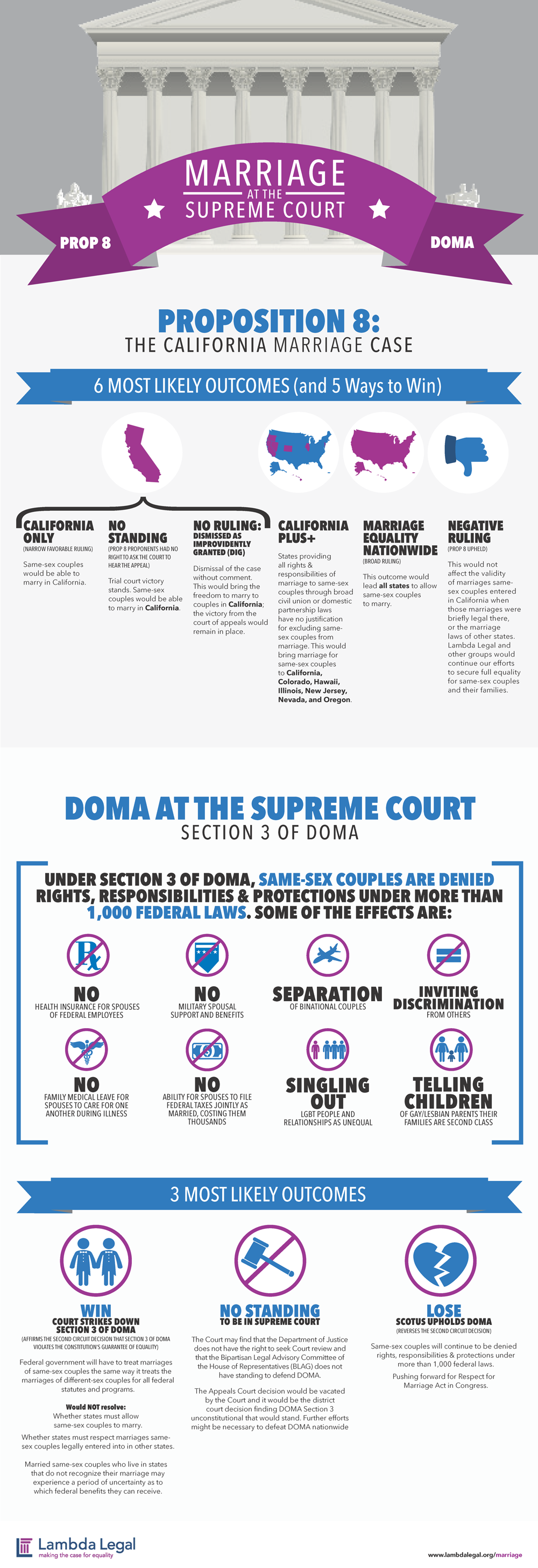
Now that Clause 3 of DOMA has fallen, those of us who are legally married now have Federal recognition and access to over 1000 rights and responsibilities under federal law. Those of us who are DP's or CU'd? Not so much. From the WaPo:
The Obama administration will not extend federal-worker benefits to domestic partners under the Supreme Court ruling that overturned part of the Defense of Marriage Act, meaning the government will treat civil unions differently than legal same-sex marriages.

The Office of Personnel Management made that announcement in a series of memos to federal benefits administrators and insurance carriers, saying couples who are not legally married “will remain ineligible for most federal benefits programs.” However, any existing benefits provided to domestic partners will remain intact, OPM said.
So, what does this mean? In a state like New Jersey, where the legislature has tried to pass of civil unions as "the same," and have been challenged in court, now there is concrete evidence that civil unions and domestic partnerships are NOT the same as marriage. From Think Progress:
Four states continue to offer civil unions: Hawaii, Colorado, Illinois, and New Jersey (Rhode Island’s civil unions will end August 1 when the marriage equality law takes effect). Though Colorado would require a constitutional amendment to upgrade civil unions to marriages, the decision has a profound impact on legislative efforts in the other three states. Lawmakers in each have argued that civil unions are satisfactory and provide the same benefits as opposite-sex couples’ marriages, but under federal law that is no longer true. This is particularly true in New Jersey, where the state Supreme Court ruled that same-sex couples deserve complete equality, so civil unions offered there are now a violation of the state’s constitution.
Those states are now on the front line for marriage equality.  Because as we've said here all along, CIVIL UNIONS ARE NOT MARRIAGE.  And now the government agrees.

Tuesday, July 2, 2013

How history supports the SCOTUS decisions on marriage

Rarely have historians played as important a role in shaping the outcome of a public controversy as in the same-sex marriage cases.... 
Briefs filed with the Supreme Court by the American Historical Association and the Organization of American Historians demonstrated that far from being a static institution, marriage has profoundly changed its definition, roles, and functions, and that today's dominant marital ideal, emphasizing emotional intimacy, has nothing to do with gender. Currently, marriage's foremost public function is to distribute benefits, such as those involving health insurance, Social Security, and inheritance, making it all the more valuable for same-sex couples. 
... the historians showed that two broad themes characterize the shifting law of marriage in the United States. The first is the decline of coverture, the notion that a married woman's identity is subsumed in her husband's. A second theme is the overturning of earlier restrictions about who can marry whom.
...
Marriage today bears scant resemblance to marriage even half a century ago, when the male breadwinner family prevailed and dual-earner and single-parent households were far rarer than today. The contemporary notion of marriage as an equal, gender-neutral partnership differs markedly not only from the patriarchal and hierarchical ideals of the colonial era, but from the notion of complementary spousal roles that predominated during the age of companionate marriage that prevailed from the 1920s into the mid-1960s.
Change, not continuity, has been the hallmark of the history of marriage. ... 
History, in the same-sex marriage controversy, was not simply "preface" -- an interesting but ultimately insignificant detail in cases involving equal treatment under law. History lay bare a series of dangerously misleading assumptions -- above all, the notion that same-sex marriage deviates from a timeless, unchanging marital norm.

Tuesday, March 26, 2013

Arguments TODAY in front of Supreme Court

Oral arguments on both the Prop8 and DOMA cases will be held today in the Supreme Court. There will also be demonstrations pro and anti. Follow all the action on Scotusblog.

Monday, March 25, 2013

Wear Red on Tuesday!

In advance of Tuesday's SCOTUS arguments on marriage equality:

1.  Wear red in support of equality!
2.  Participate in peaceful pro-equality demonstrations, in Washington DC and beyond.

It's time!

Sunday, March 24, 2013

Wednesday, February 27, 2013

Long list of big companies come out against Prop8

As the amici briefs regarding the Prop8 case come in, here's another worth noting:
The justices will hear arguments March 26 on California’s Proposition 8, the 2008 ballot initiative that halted gay marriage in the state after it was allowed for five months.
The corporate group, which also includes Facebook Inc. (FB) and Intel Corp., (INTC) will argue in its brief that gay-marriage bans in 41 states harm workplace morale and undermine recruiting. 
“No matter how welcoming the corporate culture, it cannot overcome the societal stigma institutionalized by Proposition 8 and similar laws,” the companies will argue.
...

The publicly traded companies backing gay marriage include Abercrombie & Fitch Co. (ANF),Alcoa Inc. (AA), American International Group Inc. (AIG), Becton Dickinson & Co., EBay Inc. (EBAY), Marsh & McLennan Cos. (MMC), NCR Corp. (NCR), Nike Inc. (NKE), Oracle Corp. (ORCL), Office Depot Inc. (ODP), Panasonic Corp. (6752), Qualcomm Inc. (QCOM), Sun Life Financial Inc., Xerox Corp. (XRX), Zynga Inc. (ZNGA), Barnes & Noble Inc. and Caesars Entertainment Corp. 
A larger group of companies -- more than 200, including Goldman Sachs Group Inc. (GS) -- is also poised to side with gay- rights advocates in a second Supreme Court case, involving a federal law that defines marriage as a heterosexual union. Under that law, known as the Defense of Marriage Act, legally married gay couples can’t claim the federal tax breaks and other benefits available to opposite-sex spouses. 
The companies in that case are part of a collection of more than 250 employers, including cities, counties and law firms.
So if the pro-gay rights lobby includes businesses and prominent REpublicans, just who is the anti-gay rights lobby?


Thursday, February 7, 2013

Taking down the marriage=procreation argument....biblically! (Voices of Faith)

As you know one of the primary arguments being made in front of the Supremes about marriage equality is that straight marriage is "special" because it can generate children (inadvertently, even!) and for that reason, we can't call gay relationships marriage.  (Even though we can call infertile or elderly couples "married".)  It's not as though there is a limited amount of marriage to go around, so this argument doesn't really defend straight marriage against Teh Gayz.
Click image for more
Voices of Faith

This week, the Rev. Tobias Haller, BSG, an Episcopal priest, published a piece on his blog taking down the Genesis version of this argument.  (If you haven't visited his blog before, you will find there articulate and intelligent support of marriage equality from a theological perspective.)
...But as is surely obvious, heritability and offspring ....represent possibilities which, even if not realized, do not in any way lessen the reality of the marriage itself.

The “reason” given for marriage in Genesis 2 is not procreation, but loneliness. The “reason” for marriage given in 1 Corinthians is not children, but as a remedy for fornication. And clearly these two things — companionship and conjunction — are matters for the couple, and between them; that is, they subsist in the marriage itself. ....
And if someone were to point me to Genesis 1 to claim that it shows that marriage is about procreation, given the command to be fruitful and multiply, I would have to ask why birds and fish do not “marry” — given that they receive an identical command.
... [M]arriage is about the couple and their bond and covenant. It is not a bond and covenant — or contract — to produce children, since that might well not happen, and the marriage is not void if no children are produced. It is a bond and covenant to remain faithful to the spouse, just as the marriage vows spell out in detail, with no reference to offspring: loving and cherishing, having and holding, honoring and comforting, and above all, forsaking all others in an exclusive life-long relationship. 
If you are interested in additional well-grounded theological arguments in favor of equality, I highly recommend Tobias's book, Reasonable and Holy.  

Friday, January 25, 2013

BLAG lacks standing?

One of the arguments SCOTUS requests regarding the DOMA case is whether or not BLAG (the Republican Congressional committee that is funding the campaign to defend DOMA) has standing to do so (and spend $3million of your tax dollars while they are at it). The Court asked a disinterested party, a Harvard law professor, to study the law and provide a legal opinion.

  TOday, she said, No.
In the filing, the professor, Vicki Jackson, argued:
The United States' agreement with the courts below (and with Windsor) deprives this Court of jurisdiction, because the United States suffers no injury sufficient to invoke Article III jurisdiction.
In discussing why the House Bipartisan Legal Advisory Group — the 3-2 Republican majority of which voted to take up the defense of DOMA after the administration's 2011 decision to stop defending the law — does not have the authority, or standing, to be there, Jackson argued:
It is the Executive Branch, not Congress, that is obligated to "take Care" that laws are enforced. Moreover, any injury that might arise from nondefense of a law would be to the whole Congress, which one House cannot alone assert.
But note this:
The Supreme Court appointed Jackson to argue these positions because, presumably, the justices decided they wanted a view outside of the views presented before lower courts on these questions. By the terms of that appointment, then, it was expected that Jackson would be arguing these views.

This is their "out" on the DOMA case.  Of course, then they leave DOMA in a mess, because it would be applicable in some circuits and not others.  (At least, Clause 3, which is the only clause under challenge, and is the clause regarding federal recognition of marriage.)

Tuesday, January 15, 2013

Congress spends YOUR money to defend DOMA, ctd

You know how the Republicans are all for smaller government, and less government spending?  But that's not if government spending can marginalize the gays.  THAT, and they're all in favor.

From the HuffPo:
House Republican leaders have signed on to spend up to $3 million to keep defending the Defense of Marriage Act in court, according to a copy of their newly revised legal contract obtained by The Huffington Post.  
House Republican leaders took over the legal defense of DOMA in the spring of 2011, when Attorney General Eric Holder announced the Obama administration would no longer defend it on the grounds that they found it unconstitutional. House Speaker John Boehner (R-Ohio) and other GOP leaders hired attorneys at the law firm Bancroft LLC to represent the House in court cases involving the federal ban on gay marriage -- all with taxpayer dollars....

House Democratic leaders, meanwhile, sent a letter to Boehner later Tuesday voicing their opposition to sinking more money into DOMA's defense -- particularly given Republicans' calls for fiscal responsibility. 
"We wish to strongly reaffirm our objections to the repeated actions by the Republican leadership to secretly and dramatically increase the contract between the House and outside counsel in arguing to uphold the discriminatory Defense of Marriage Act (DOMA) in more than a dozen cases," reads the letter from House Minority Leader Nancy Pelosi (D-Calif.) and House Minority Whip Steny Hoyer (D-Md.). 
"It is the height of hypocrisy for House Republicans to waste public funds in one breath then claim the mantle of fiscal responsibility in the next," the letter continues. "With Republicans willing to take our economy and our country to the brink of default in the name of deficit reduction, there is simply no excuse for any Member of Congress to commit taxpayer dollars to an unnecessary -- and futile -- legal battle."

Monday, January 7, 2013

Buckle your seatbelts, here we go again

The Supreme Court has announced the date for oral arguments in the gay marriage cases. From Scotusblog:
The Supreme Court on Monday released the schedule of oral arguments for the sitting that begins March 18, showing that the two cases on same-sex marriage will be heard — one on each day — on Tuesday, March 26, and Wednesday, March 27. The case on California’s “Proposition 8″ will come first, followed by the case on the constitutionality of the federal Defense of Marriage Act; each case is scheduled for one hour of argument, although the fact that each is to be heard alone will allow the argument time to be expanded, and that appears likely.

Monday, December 17, 2012

The Standing Issue on the Prop8 case

As well as hearing arguments on the Constitutionality of Prop8, the Supreme Court has asked to be briefed on the issue of "standing":  that is, whether the proponents of Prop8 have the right to appeal the decision, given the State's unwillingness to do so.

Some people think this may offer the court an "out" to avoid finding one way or the other on marriage. If the Prop8 supporters lack standing (since they can't demonstrate any actual harm to them caused by Prop8), the whole thing becomes rather messy, but remains limited to California.

From Linda Greenhouse at the NY TImes:
Standing has been an issue in the Proposition 8 case ever since the state of California decided not to appeal Federal District Judge Vaughn Walker’s 2010 ruling that the proposition was unconstitutional. The appeal to the United States Court of Appeals for the Ninth Circuit was carried on by a group of people who had worked to get the proposition adopted. The Ninth Circuit questioned whether this group had the requisite Article III standing, and asked the California Supreme Court to tell it whether under California law, a ballot measure’s proponents are regarded as properly standing in the state’s shoes if the state decides not to defend the measure. When the state court answered yes, the Ninth Circuit took the answer as sufficient and proceeded to decide the appeal, finding Proposition 8 unconstitutional. 
Whether standing under state law translates into standing for the purposes of Article III is a question that the United States Supreme Court has poked at but never resolved. Whether this is the right case in which to do so remains to be seen, but it was not particularly surprising for the court to raise the issue. In fact, in an era of direct democracy run amok, with voters being presented with extreme propositions that no rational state government would wish to embrace, a Supreme Court decision on who can carry the ball into federal court is probably overdue.
This was part of the appellate litigation for Prop8, so the existing attorneys have already briefed on this. 

Lyle Denniston at ScotusBlog tells us the court has identified an outside lawyer to argue the standing issue for the DOMA case.  The issue there is a little different than for Prop8, and I believe that it hasn't been part of the case previously, hence the outside lawyer.

Sunday, December 9, 2012

A very long engagement: about Edie Windsor (Video Sunday)

Edie Windsor is the plaintiff in Windsor v. United States, which is the DOMA case that the Supreme Court has decided to hear.

This is her story.

Monday, December 3, 2012

Will Friday be the day?

The estimable Scotusblog (@scotusblog) tweets today,

#scotus is almost sure to act on same-sex marriage (#ssm) late this Friday afternoon so it can hear arguments this March.

Friday, November 30, 2012

The Supreme Court decides....

Not to decide.  At least, not today.  They may tell us on Monday.  Or Tuesday,  Possibly next Friday.  Or maybe the Monday after that.

Here's a detailed overview on what the cases are and what we might expect.

From an op/ed at ScotusBlog:
I have never before seen cases that I believed would be discussed two hundred years from now.  Bush v. Gore and Obamacare were relative pipsqueaks.  The government’s assertion of the power to prohibit a loving couple to marry, or to refuse to recognize such a marriage, is profound.  So is the opposite claim that five Justices can read the federal Constitution to strip the people of the power to enact the laws governing such a foundational social institution.
...
The striking feature of these cases – not present in any others I have ever seen – is that that they would have been decided by the Justices’ predecessors one way and would be decided by the Justices’ successors another way.
….
Our country and societies around the world will read the Justices’ decision(s) not principally as a legal document but instead as a statement by a wise body about whether same-sex marriages are morally right or wrong.  The issues are that profound and fraught; they in a sense seem to transcend “law.”  Given the inevitability of same-sex marriage, if the Court rules against those claiming a right to have such unions recognized, it will later be judged to be “on the wrong side of history.” 
But the verdict of history cannot decide the legal questions presented by these cases.  The cases arrive today, in this moment, before our cultural transition has completed.  In a sense, it is a shame that there is such pressure to hear the cases now; the judgment for the rest of the nation’s history would certainly favor these claims.  But if they do decide to grant review, the Justices cannot merely choose to embrace the past or the future.  They will have to make a judgment now

Wednesday, November 28, 2012

Four possible outcomes from the Supreme Court

On Friday, the court will conference on whether to hear any of the cases before it (Prop8, several DOMA cases, and a case from AZ on partner benefits). From Chris Geidner, a consideration of the possible outcomes. I'm hoping for version 4.

• The court takes multiple DOMA cases and the Proposition 8 case. This outcome would be the “all in” option, and it would make clear that at least four justices want the court to resolve the legal questions surrounding these issues, from what level of scrutiny that laws classifying people based on sexual orientation should be given (see more about this here) to whether gay couples have a constitutional right to marry..... 
• The court takes one DOMA case, while holding the other DOMA cases pending that decision, and takes the Proposition 8 case as well. This is not very different from the first possibility, although the choice of one DOMA case over another could be seen as narrowing the type of argument about the law that the court would like to hear. ... 
• The court takes a DOMA case (or multiple DOMA cases) and holds the rest of the cases, including Proposition 8, pending the outcome of the DOMA case. This prospect, advanced as a possibility by Georgetown law professor Nan Hunter, could be taken by a cautious court, wanting first to resolve some general questions — including the level of scrutiny to be applied to sexual orientation classifications — before acting on the other, more direct, question about whether same-sex couples have a constitutional right to marry that is raised in the Proposition 8 challenge. .... 
• The court takes a DOMA case (or multiple DOMA cases), but denies certiorari in the Proposition 8 case. This option, once considered by advocates to be the most likely possibility, would lead to same-sex couples being able to marry in California within days. The Ninth Circuit’s ruling in the case did not broadly resolve the marriage question, instead holding that Proposition 8 was unconstitutional because it took back rights formerly held by Californians. As there are other cases in the legal pipeline about same-sex couples marriage rights that could make their way to the Supreme Court, the court could decide to let the narrow Ninth Circuit decision stand.

Monday, November 12, 2012

What did SCOTUS hear?

Did the election make a difference to the SCOTUS? The opponents of marriage equality are arguing that the fact that 3 states approved marriage equality at the ballot box shows that gays are not "politically powerless" and therefore don't deserve protection. (NB: MN only decided not to forbid it in the COnstitution; same sex marriage is illegal there already). The fact that 30-odd states have found otherwise would argue against that interpretation. This article in the Washington Post considers how the Court will wade in.
Supporters of same-sex marriage say the votes — along with polls showing acceptance of gay marriage high among younger Americans — point to inevitable momentum, but not so much that the court should leave the question of equal rights to the political process. “At the end of the day, it’s the reason we have the judiciary — to protect the rights of the minority,” Griffin said.
In any event, there is basically no chance they will find that there is a federal right to marry. The hope is that they don't overturn the Prop8 case, and just let it apply to CA, perhaps by denying cert (that is, refusing to hear it).
But the court is almost obligated to take one or more of the DOMA cases. As the state of play now stands, it would be unconstitutional to withhold federal recognition — there are more than 1,100 references to marriage in federal laws, codes and regulations — to same-sex couples married in the Northeast states covered by the U.S. Courts of Appeals for the 1st and 2nd circuits. But the decisions don’t apply to those married in Iowa, the District of Columbia or those states that Tuesday approved gay marriage. 
About 15 percent of Americans now live in states that allow gay marriage, and the number would double if the right were reinstated in California.
The Post article also says that the Supreme Court's conference on whether or not to hear the Prop8 or DOMA cases has been postponed to Nov. 30. I haven't seen confirmation of that.

Update:  AFER confirms that the conference is indeed rescheduled to Nov 30th.  We may hear something about it on 3rd Dec.

Thursday, October 18, 2012

NEWS: DOMA found unconstitutional by 2nd circuit

...that would be the second appeals court that has found DOMA unconstitutional.  (The first being the first circuit).  Even sweeter, it came from an extremely conservative judge.  Best of all, it finds heightened scrutiny applies:
In this case, all four factors justify heightened scrutiny: A) homosexuals as a group have historically endured persecution and discrimination; B) homosexuality has no relation to aptitude or ability to contribute to society; C) homosexuals are a discernible group with non-obvious distinguishing characteristics, especially in the subset of those who enter same-sex marriages; and D) the class remains a politically weakened minority.
And does a nice knock-down to the defenders of DOMA, the Congressionally-funded BLAG:
BLAG argues that, unlike protected classes, homosexuals have not "suffered discrimination for longer than history has been recorded." But whether such discrimination existed in Babylon is neither here nor there. BLAG concedes that homosexuals have endured discrimination in this country since at least the 1920s. Ninety years of discrimination is entirely sufficient to document a "history of discrimination."
This is the Edie Windsor case, who was legally married but wiped out financially because of estate taxes of her wife.  Unusually, it's already been sent to the Supreme Court, as part of a cluster of DOMA cases.