Showing posts with label Loving v. Virginia. Show all posts

Monday, February 23, 2015

A reminder: no arguments are new

Although we've covered this ground before, it's worth remembering that the arguments made against same sex marriage equality are very like those made against inter-racial marriage.

I mean, doesn't this sound familiar?
First, there's the "slippery slope" idea, which says that if we allow gay marriage, we have to allow all kinds of stuff. ..... But the argument was made by R. D. McIlwaine III, then Virginia's assistant attorney general, in Loving v. the State of Virginia, the 1967 Supreme Court case that overturned miscegenation laws:
It is clear from the most recent available evidence on the psycho-sociological aspect of this question that intermarried families are subjected to much greater pressures and problems then those of the intermarried and that the state's prohibition of interracial marriage for this reason stands on the same footing as the prohibition of polygamous marriage, or incestuous marriage or the prescription of minimum ages at which people may marry and the prevention of the marriage of people who are mentally incompetent.
Then there's the "think of the children" line, which says that kids raised by two parents of the opposite sex are better off than those who aren't. ..... McIlwaine made that case too:
Now if the state has an interest in marriage, if it has an interest in maximizing the number of stable marriages and in protecting the progeny of interracial marriages from these problems, then clearly. there is scientific evidence available that is so. It is not infrequent that the children of intermarried parents are referred to not merely as the children of intermarried parents but as the 'victims' of intermarried parents and as the 'martyrs' of intermarried parents.
And of course, other arguments are also familiar from the anti-miscegenation laws.
1) First, judges claimed that marriage belonged under the control of the states rather than the federal government. 
2) Second, they began to define and label all interracial relationships (even longstanding, deeply committed ones) as illicit sex rather than marriage. 
3) Third, they insisted that interracial marriage was contrary to God's will, and 
4) Fourth, they declared, over and over again, that interracial marriage was somehow "unnatural." 
On this fourth point--the supposed "unnaturality" of interracial marriage--judges formed a virtual chorus. .... 
The fifth, and final, argument judges would use to justify miscegenation law was undoubtedly the most important; it used these claims that interracial marriage was unnatural and immoral to find a way around the Fourteenth Amendment's guarantee of "equal protection under the laws." How did judges do this? They insisted that because miscegenation laws punished both the black and white partners to an interracial marriage, they affected blacks and whites "equally." ....During the late 19th century, this judicial consensus laid the basis for an ominous expansion in the number, range, and severity of miscegenation laws. In Southern states, lawmakers enacted new and tougher laws forbidding interracial marriages. Seven states put miscegenation provisions in their state constitutions as well as in their regular law codes, and most raised criminal penalties to felony level.
The arc of history is indeed long. 

Wednesday, October 8, 2014

Inter-racial marriage vs same-sex marriage

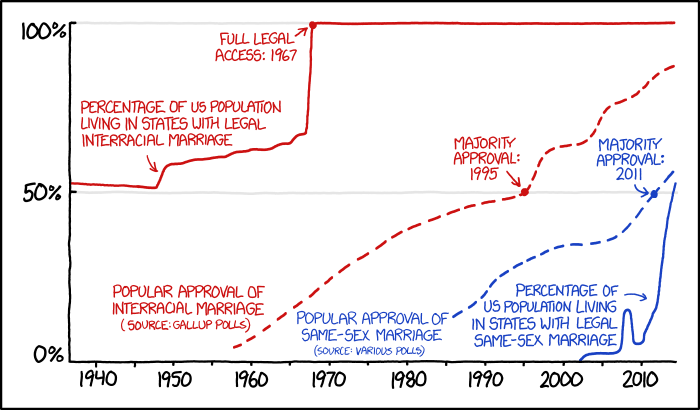
I've made this comparison before (e.g., here) but now someone else has managed to get it noticed more broadly.  You'll note that the slope of the two "approval" curves is very similar.  What's not similar is that if this were truly parallel, marriages between same sex partners would have been legal in ca. 1990.


Just for grins, here's my version from 2012:


Friday, September 5, 2014

Posnered: the 7th circuit speaks

In a unanimous decision, the 7th Circuit Court of Appeal found that the marriage bans in Wisconsin and Indiana are unconstitutional.  What everyone is talking about is the scathing opinion by Judge Posner, a Reagan appointee who is widely considered to be one of the most influential living jurists.  From the opinion, summarizing the states' argument:
Heterosexuals get drunk and pregnant, producing unwanted children; their reward is to be allowed to marry. Homosexual couples do not produce unwanted children; their reward is to be denied the right to marry. Go figure.
From Slate,  an analysis,
There is simply no harm, Posner writes, “tangible, secular, material—physical or financial, or … focused and direct” done to anybody by permitting gay marriage. Conservative Christians may be offended, but “there is no way they are going to be hurt by it in a way that the law would take cognizance of.” A lot of people, after all, objected to interracial marriage in 1967—but that didn’t stop the court from invalidating anti-miscegenation laws inLoving v. Virginia.

In his opinion, Posner makes these points with trenchant humor. But beneath his droll wit lies a moral seriousness that gay marriage opponents, even those on the high court, will be unable to shrug off. The modern arguments against gay marriage may be breathtakingly silly—but by mocking them, we ignore the profound harms that marriage bans inflict on gay people and their families. By placing these families at the center of his analysis, Posner restores the equal protection clause to its rightful place as the safeguard for all whom the state seeks to harm unjustly. His message for those who hope to demean gay people and their children is clear: Not on my watch.

From Twitter, the neologism Posnered, meaning to reduce an argument to rubble.


Wednesday, May 22, 2013

Why we need the courts: equality comes to a halt.

Although marriage equality has lept ahead of late, we're about to come to a screeching halt.
Recent victories have given same-sex marriage advocates hope that the tide has turned in their long-running fight for marriage equality, given the number of states approving same-sex marriage has doubled since Election Day 2012. 
But 36 states still ban such unions, and there’s little sign of change in those states anytime soon. 
While national public opinion polls show Americans warming to same-sex marriage, voters in many states remain staunchly opposed. And even where the politics and sentiment have changed, bans enshrined in many state constitutions could prove especially difficult to overturn — exactly the reason opponents pushed for constitutional measures in the first place.
 Those anti-equality amendments in state constitutions are going to be hard to change one by one....and some of them are not going to change at all.  From the Guardian:
Republicans have at least partial control of all the legislatures near the border and in the deep south. ... Republican control is a big deal because though the rest of the country has moved, Republicans, especially southern Republicans, have not. Only 26% of Republicans support gay marriage. The percentage of Americans in favor of same-sex marriage rose by 15pt over the past decade; the percentage of Republicans favoring gay marriage only rose by 3pt over the same period. That's a growth rate of only 0.3pt a year. 
...With the exception of Virginia, it's pretty clear that southern Republican support for gay marriage is lower than among Republicans nationally. As such, it's difficult to see how support among southern Republicans will hit 50% anytime before 2040. It's hard to imagine more than the stray Republican voting for same-sex marriage. Polarization is at all-time high, and politicians are more afraid about losing primaries than general elections. Republicans have no need to vote for same-sex marriage. 
Thus, unless the federal government jumps in, most, if not all southern states won't legalize same-sex marriage for the foreseeable future. Most of their citizens don't want it, and by the time they do, most Republicans still won't. Considering you'll need a majority or supermajority of state legislators to get the bans reversed, and that Republicans have a strong hold over these chambers, same-sex marriage in the south doesn't have much of a chance anytime soon.
The same thing happened with anti-miscegenation laws.  They essentially only remained in the south, until the Supreme Court's Loving v. Virginia decision finally eliminated them.  (And, tellingly, Republicans in the south still oppose inter-racial marriage).

Despite the pace of change, most court watchers think that SCOTUS will not make any sweeping decisions about marriage.  The best we can hope for is that Prop8 falls in California, but even that is uncertain-- and depending on the nature  and scope of the decision, it may only apply to the two couples who brought the case.

But it is clear that until SCOTUS DOES make such a decision, marriage equality will not be the law of the land, because of the frankly retrograde south.

Tuesday, December 11, 2012

Why the Supreme Court is unlikely to vote for equality

I am not happy the SCOTUS took the Prop8 case.  I fear that they will find that states are perfectly entitled to forbid equality (thus upholding Prop8) and we will be sentenced to a long, hard slog through the ballot box, even if they over turn Clause 3 of DOMA.  Here's why I think so:

From the NY Times:
In private correspondence in 1957, Justice Felix Frankfurter said the court was doing all it could to avoid hearing cases that would require giving the nation an answer about whether bans on interracial marriage — anti-miscegenation laws, in the parlance of the day — were constitutional. 
“We twice shunted it away,” Justice Frankfurter wrote to Judge Learned Hand, “and I pray we will be able to do it again without being too brazenly evasive.” 
Judge Hand responded that “I don’t see how you lads can duck it.” 
But Justice Frankfurter was unpersuaded. 
“I shall work, within the limits of judicial decency,” he wrote, “to put off decision on miscegenation as long as I can.” 
The Supreme Court did not strike down laws banning interracial marriage until 1967, inLoving v. Virginia, when 16 states still had them on the books. That was almost two decades after the California Supreme Court in 1948 struck down a law making illegal “all marriages of white persons with Negroes” in Perez v. Sharp. 
It has been just four years since the California Supreme Court, citing Perez, struck down two state laws limiting marriage to a man and a woman. 
“We are in the midst of a major social change,” Justice Carol A. Corrigan wrote in dissent. She said she supported allowing “our gay and lesbian neighbors” to marry. But she said change must come from the political process, not the courts. 
“Societies seldom make such changes smoothly,” Justice Corrigan wrote. “For some the process is frustratingly slow. For others it is jarringly fast.”

Saturday, December 8, 2012

More legal analysis

Two from Soctusblog, well worth reading.

Lyle Denniston considers the standing issue
But besides accepting for review the questions raised in those two petitions, going to some of the fundamental constitutional disputes over marriage laws, the Court — somewhat at the prompting of some of the parties — added questions to each case about its authority to rule. The added questions themselves are constitutional in nature: they arise under Article III, and its grant of power to the federal courts. But that is a power to decide only a “live” case or controversy, and that means there have to be two sides with the legal right to be in court before Article III can be satisfied.
Kenji Yoshino on how the Prop8 case could be "incremental"
DOMA represents an intrusion of federal law into the traditional state domain of family law. As the lower courts have pointed out through various formulations, invalidating DOMA would represent a triumph for state sovereignty as well as for gay rights. Justices on the right tend to favor state power (relative to federal power); Justices on the left tend to favor gay rights. The Justice in the middle—Justice Kennedy—has historically favored both. 
The second premise is that the Court will wish to proceed incrementally—that it will not, in one Term, strike down DOMA and flip the forty-one states that do not currently recognize same-sex marriage. Here, too, I agree. In 1967, when the Court decided Loving v. Virginia, it only had to invalidate the laws of sixteen states. In general, the Court does not like to get too far in front of national consensus. 
It might seem to follow from these two premises that the Court will split the baby between the cases. But the error lies in thinking that the Perry Court must require marriage in all fifty states or none. In fact, the Court can more narrowly invalidate Prop 8 in at least three ways.

Thursday, September 6, 2012

Slippery slopes and other fallacies

Well, now they've done it. In Brazil, a judge has legitimized a three-way relationship, and now the fundies are all shrieking "see, we knew it!  next, people will marry their dogs!"

This is all part of the "slippery slope" logical fallacy, which states that "once X happens, how will you stop Y?"  And the answer is, the same way you stop Y now.  X has nothing to do with Y.

Legalizing marriage between two unmarried adults in no way changes bars to polygamy.  Sorry, uh-uh, just doesn't do it.  Just as marriage between a man and a woman does not promote marriage between a man and many women, or between a brother and sister (all of which are man-woman marriages.)
I also found this article comparing (again) the movement against inter-racial marriage to same-sex marriage.  And, yes, the slippery slop argument was used there too:
It is clear from the most recent available evidence on the psycho-sociological aspect of this question that intermarried families are subjected to much greater pressures and problems then those of the intermarried and that the state's prohibition of interracial marriage for this reason stands on the same footing as the prohibition of polygamous marriage, or incestuous marriage or the prescription of minimum ages at which people may marry and the prevention of the marriage of people who are mentally incompetent.
Same argument.

Still false!

BTW, I am a firm believer that marriage is between two people.

Thursday, May 24, 2012

We've heard these arguments before.

Does this quote surprise you? From the Supreme Court of Virginia:
The purity of public morals," the court declared, "the moral and physical development of both [sexes requires] hat connections and alliances so unnatural that God and nature seem to forbid them, should be prohibited by positive law, and be subject to no evasion.
That's in keeping with Virgina being a state of hate, and utterly in keeping with the brutal anti-gay rhetoric we saw from North Carolina, in the run up to a hate amendment more extreme than Prop8. In NC, anti-gay "Christians" insisted that gay children should be beaten to "cure" them, and that gay men use cell phones as sex toys.

 Except that the quote comes from 1878 years ago, in a decision about inter-racial marriage laws. I changed the words in the bracket. (The correct quote is below).

 I recently read an excellent article discussing the efforts to outlaw inter-racial marriages, including efforts to amend the US constitution:
Here are four of the arguments they used:
1) First, judges claimed that marriage belonged under the control of the states rather than the federal government.
 2) Second, they began to define and label all interracial relationships (even longstanding, deeply committed ones) as illicit sex rather than marriage.
 3) Third, they insisted that interracial marriage was contrary to God's will, and
 4) Fourth, they declared, over and over again, that interracial marriage was somehow "unnatural." 
Does this sound familiar? It seems that anti-marriage equality advocates are really just the same as the racists of 150 years ago.
 The fifth, and final, argument judges would use to justify miscegenation law was undoubtedly the most important; it used these claims that interracial marriage was unnatural and immoral to find a way around the Fourteenth Amendment's guarantee of "equal protection under the laws." How did judges do this? They insisted that because miscegenation laws punished both the black and white partners to an interracial marriage, they affected blacks and whites "equally." 
This is no different than the argument that laws against gay marriage aren't unequal, because a gay man can marry a woman. (Would they want a gay man to marry THEIR daughter?) Oh, and the slippery slope argument? You know, that once we let "X" people marry, there will be incest and polygamy? Yup, they used that too.

Now, being black is not the same thing as being gay. Neither is being a woman. Neither is being a Jew.   The discrimination experienced by each minority group is unique to that minority. Yet it is also the same, because bias and bigotry are the same regardless of their target.  

Thus it behooves us to recognize that racism, sexism, heterosexism, and other "isms" are all rooms in the same house, one that would define some of us as "second class" simply because of who we are, or who we love, or what we believe.  The great achievements of the Civil Rights Movement stand as beacons to any group that is struggling for recognition. Dr Martin Luther King remains an inspiration to all of us, not just African Americans.

And thus, yes, we can take hope from the progress on civil rights for other groups, and hope that the arc of history really WILL bend towards justice.


The quote comes frome a decision in 1878:
The purity of public morals," the court declared, "the moral and physical development of both races….require that they should be kept distinct and separate… that connections and alliances so unnatural that God and nature seem to forbid them, should be prohibited by positive law, and be subject to no evasion.

Friday, April 27, 2012

Inter-racial marriage vs same sex marriage polls (by the numbers, revised)

People are noticing new poll results, in keeping with other recent polls indicating that a plurality, if not a majority of Americans now support the right of gay couples to marry.

I think it's interesting to compare this to approval of inter-racial marriage. A couple of years ago I compared the rate of approval of inter-racial marriage to that of approval of marriage between same sex couples, using data from different polls*.

I've revised the graph with the newest poll numbers and added some landmarks.

I want you to notice a couple of things, as I've noted before.  First, at the time of Loving v. Virginia, in which the Supreme Court overturned anti-miscegenation laws and declared inter-racial marriage legal, only 20% of Americans approved of such marriages.

Compare this to the 27% percent who already approved of marriage equality when DOMA passed, which prevented the recognition of same sex marriages.  20% approved when we legalized inter-racial marriage, 27% approved when we essentially de-legalized same sex marriages.

At the time marriage equality for gay couples was approved in Massachusetts (2003) about 35% of Americans approved. It took 10 years after the Loving decision for the numbers to reach that point.  That is, only  10 years AFTER inter-racial marriage was legal, did that many people agree with it.

We're now just below 50% on approval of same sex marriage (sometimes a few points up, sometimes a few points down). It took 25 years AFTER inter-racial marriage became legal, to reach that point.  So at the same point of approval of inter-racial marriage that we're at now, it had already been legal for 25 years.

Why are we still fighting this battle?

*Method:  For this analysis, I assigned a starting year to the absolute value "0" (1968 for inter-racial data).  Each data point was then plotted based on how many years had elapsed since year "0".  I then registered the same sex marriage data against the inter-racial marriage data based on the nearest value (that is, 1996 for same sex marriage was closest to 1972 for inter-racial marriage). The density of points for same sex marriage relative to the inter-racial marriage reflects the difference in frequency of polling the questions.

*Inter-racial marriage from two Gallup polls here and here
*Same sex marriage from two Pew polls here and here
More Pew data analysis here


Thursday, March 1, 2012

No one is "redefining marriage"

Laurel Ramseyer:
[L]aws permitting civil marriage for same-sex couples don’t redefine civil marriage. What those laws do is extend access to civil marriage to couples of the same sex. 
In a similar vein Anne Levinson, who is coordinating the challenge to the Washington Attorney General’s proposed ballot title for Referendum 74 has said, “laws that eliminate bans on inter-racial marriage and laws that eliminate bans on marriage for same-sex couples don’t redefine marriage. What these laws do is extend the rights and responsibilities of civil marriage to couples who were previously denied marriage licenses by their government. The meaning of marriage remains unchanged. The marriage laws themselves remain unchanged. The responsibilities and rights of married couples remain unchanged. Nobody’s civil marriage is in any way redefined, nor is the meaning of marriage changed or the clergy’s complete religious freedom to perform or celebrate or not perform or celebrate any marriage in accordance with their beliefs.” 

The catchphrase “redefine marriage” is a dodge from the real discussion at hand: permitting same-sex couples access to civil marriage.
As she notes, we didn't consider voting "redefined" when we allowed black men (1870) or women (19120) to vote.  We didn't consider marriage "redefined" when we eliminated anti-miscegenation laws.  Extending rights to all is not a "redefinition".  Call them out on this!


Sunday, June 12, 2011

Loving v. Virginia: video Sunday

It's the 44th anniversary of the landmark Loving v Virgina decision by the Supreme Court that overturned anti-miscegenation laws.

Monday, February 28, 2011

New poll on SSM; how long do we wait?

From Sarah Posner at Religion Dispatches:
Sherkat performed the analysis on the GSS data following the publication of his 2010 paper, "Religion, politics, and support for same-sex marriage in the United States, 1988–2008," published in Social Science Research. That paper concluded (as the above data through 2008 showed) that public opinion was indeed trending upward for support for same-sex marriage and downward for opposition, and noted, "Our findings suggest that in a little over a decade the majority of Americans will support the legalization of same-sex marriage." While the 2010 data doesn't show an over-50% majority, it does show, far more quickly than Sherkat expected, support outpacing opposition.
The data indicate that nearly everyone is modernizing except "sectarian PRotestants" and Republicans. If you identify strongly as a conservative Christian or Republican, you disapprove.

If you look at the data for inter-racial marriage, even today about 20% of Americans disapprove. I am going to bet that you will never, ever convert that rump of conservative evangelical Republicans to support same sex marriage.

The question is, will we put the rights of the minority, and the approval on the majority, aside for the views of this group?

Monday, October 25, 2010

By the numbers: same sex marriage vs. inter-racial marriage

"Activist judges do not have the right to redefine marriage if the majority of voters disagree." That's what the marriage equality opponents tell us all the time, to justify the "right of the people" to let their opinion determine the rights of a minority group.

So let's consider what the People thought in 1968. In that year, Americans told Gallup that they disapproved of inter-racial marriage by a margin of 73%-20%. Overwhelmingly, Americans did not think people should marry across racial lines.
That's a year after the Supreme Court, in the landmark case Loving v. Virginia, legalized inter-racial marriage. Despite the fact that nearly 3/4 of Americans disapproved. How dare they! Over the voices of the mob majority, how dare they?

It wasn't until 1991, twenty three years after the decision, that a plurality of Americans approved of racially mixed marriages. The number approving has flattened out in recent polls at around 75% now. I suspect it will stay there for some time, until a particular generation dies out.

Now, let's think about marriage equality for GLBT people. When the question was asked in 1996, it was 65% opposed, 27% in favor. Pretty close to where we started with inter-racial marriage, back in the 1960s. So, I wondered: how does the trend compare? The answer is, remarkably well.


These graphs look almost perfectly superimposed. By this prediction, marriage equality will have a plurality of support by about 2019, and an overwhelming majority by 2028. Good news for our kids, eh?

But here's the thing. All these data points for inter-racial marriage come from a time when inter-racial marriage was already legal in all 50 states . We didn't wait for majority approval to remedy the injustice. In contrast, I'm sure I needn't remind you that same sex marriage is not legal yet, except in a few pockets in the country.

Further, by the time public opinion was at the point regarding inter-racial marriage as it is now for same sex marriage, inter-racial marriage had been legal for 14 years.

So please, just what in hell are we waiting for?

And next time you have to deal with the "activist judges" line, remember these data.

Method I took the data from the Gallup polls on inter-racial marriage, and the Pew polls on same-sex marriage. For this analysis, I assigned the starting year to the absolute value "0" (1968 for inter-racial data, 1996 for same-sex marriage data). Each data point was then plotted based on how many years had elapsed since year "0". The density of points for same sex marriage relative to the inter-racial marriage reflects the difference in frequency of polling the questions.

Monday, June 7, 2010

We do not live in a democracy

The US is not a direct democracy. It is a Constitutional Republic. We have a representative, not direct rule, form of government. "The People" are not required, or allowed in most cases, to vote directly, especially on matters affecting minority groups.

The Constitution lays out the terms of this Republic. Part of the genius of this document is its careful consideration of rules and policies that protect all the citizens. The Constitution provides the protections necessary so that all the people consent to be governed. The courts enforce these Constitutional protections.

Without a constitution, a simple majority could deprive any minority group of its rights. A simple majority could decide that blacks and whites should be segregated, that mixed-race marriages are illegal, that Jews have no right to practice their religion, that women aren't allowed to vote, that Hispanics have to carry special identity documents. Or that GLBT people cannot marry.

Over and over again, our Supreme Court exercises its role of comparing laws to the Constitution and ensuring that all people have equal protection. They don't always get it right, but over time, we can see a clear arc of justice. The Constitution opposes simple majority votes: the tyranny of the majority, or mob rule.

You can bet that the majority of voters in the south opposed school desegregation and the dismantling of Jim Crow in Brown v Board of Education. It is a fact that the majority of Americans opposed mixed race marriages, for decades after Loving v. Virginia.

Polls suggest a majority of Arizonans approve the state's draconian "breathing while brown" anti-immigrant law. That doesn't make racial profiling legal.

And that a majority of Californians decided to take away the rights of GLBT citizens doesn't make it right, or Constitutional. I wish the advocates of mob rule would get a civics book and learn what the Constitution is all about.

Monday, February 15, 2010

Maps: Laws against inter-racial marriage, laws against same sex marriage

The Map Scroll is a wonderful blog all about different maps. Here are two US maps from that blog. The first shows the repeal of laws against anti-miscegenation laws.


The second shows a map of the projected passage of marriage equality laws.

Notice that the South lags behind both movements. The Northeast leads the way. The West is a little different.

The MapScroll blogger writes
it took nearly 200 years between the first state ban on interracial marriage to be lifted (Pennsylvania, in 1780) and the Supreme Court decision that ended such bans once and for all. And the progress was very fitful.....

Are there lessons to be drawn here about the future of same-sex marriage? One would seem to be that progressive change is not inexorable; or if it is, it can still be delayed by quite a lot, as the 1887 to 1948 lacuna in repealing marriage bans shows. And, though the generational divide on gay marriage is really stark, according to polls like this one, which found that 41% of people under 45 support same-sex marriage, as opposed to 18% of people over 65, even young people are only split on the issue, so it would seem wrong to view the inexorable spread of marriage equality as a fait accompli.

Nonetheless, I think there are good reasons to think that an outcome in which same-sex marriage becomes broadly accepted within a generation is likely. ....The taboo on gay relationships is on the way out the door, and I can't help but think that it's only a matter of time before the law reflects this reality.

Wednesday, January 20, 2010

A conservative case for marriage equality

From Ted Olson, counsel for the plaintiffs in Perry v. Schwarzenegger, writing in Newsweek
:Marriage is a civil bond in this country as well as, in some (but hardly all) cases, a religious sacrament. It is a relationship recognized by governments as providing a privileged and respected status, entitled to the state's support and benefits. The California Supreme Court described marriage as a "union unreservedly approved and favored by the community." Where the state has accorded official sanction to a relationship and provided special benefits to those who enter into that relationship, our courts have insisted that withholding that status requires powerful justifications and may not be arbitrarily denied.
....
The simple fact is that there is no good reason why we should deny marriage to same-sex partners. On the other hand, there are many reasons why we should formally recognize these relationships and embrace the rights of gays and lesbians to marry and become full and equal members of our society.....

When we refuse to accord this status to gays and lesbians, we discourage them from forming the same relationships we encourage for others. And we are also telling them, those who love them, and society as a whole that their relationships are less worthy, less legitimate, less permanent, and less valued. We demean their relationships and we demean them as individuals. I cannot imagine how we benefit as a society by doing so.
...
Americans who believe in the words of the Declaration of Independence, in Lincoln's Gettysburg Address, in the 14th Amendment, and in the Constitution's guarantees of equal protection and equal dignity before the law cannot sit by while this wrong continues. This is not a conservative or liberal issue; it is an American one, and it is time that we, as Americans, embraced it.
It's not just Olson who has seen the light, so to speak. Fox News commentator Margaret Hoover writes,
Mr. Olson thinks constitutionally guaranteed rights ought to transcend left vs. right, Democrat vs. Republican divides (he even recruited legal opponent David Boies as co-counsel). I agree with him. And as a proud Republican representing a younger generation of conservatives that cherish individual freedom, I am honored to join the American Equal Right’s Foundation’s Advisory Board.

I encourage everyone, but especially Republicans, to consider Mr. Olson’s arguments on the merits, both in his opening statement and throughout the trial’s ensuing three weeks. The plaintiff’s counsel seeks to convince Judge Vaughn R. Walker that the Supreme Court has already decided in Loving v. Virginia, Turner v. Safely, and in Lawrence v. Texas among others, that the right to marry is a fundamental right currently denied to an entire class of American citizens. This is unconstitutional.

We Republicans have often found ourselves on the wrong side of civil rights struggles since the 1960s, but there was a reason that Martin Luther King, Jr.'s father is said to have supported Republicans.

Republicans were historically the party ever-expanding freedom to disenfranchised minorities, from newly liberated slaves to giving women the right to vote. Susan B. Anthony was a Republican. By supporting the AFER trial we have an opportunity to establish our historic credibility on civil rights issues once again. But we should support marriage equality because it is the right thing to do.....

If you are uncomfortable with gay marriage, I encourage you to pay attention to this trial, the plaintiffs, the defense and the spectrum of experts, historians, psychologists, economists, political scientists, who will testify as to the effects and detriment of Proposition 8. In the words of NAACP chairman Julian Bond, “The humanity of all Americans is diminished when any group is denied rights granted to others.”

Friday, October 16, 2009

Voting on Marriage

Many, many of the proponents of Prop8 and similar bans on marriage equality argue that the voters have spoken, and we should just shut up. What they fail to understand is something that was very clear to our Founding Fathers: pure democracy is mob tyranny. The point of the Constitution is to protect the minority from the majority, so that all consent to be governed.

In 1948, the Supreme Court of California struck down laws that prevented inter-racial marriage, in Perez v. Sharp.

In 1968, in Loving v. Virginia, the Supreme Court of the United States struck down such laws nationally.

Now, what was the view of the people? As shown by Gallup, not until 1991 did a plurality of Americans approve of inter-racial marriages. Indeed, one might argue that the decision of 1968 sped it up, and even then, the electorate only caught up with the law 30 years later.


And even today, relationships between black and white can be politically perilous. Despite having a mixed-race president in the White House.
A sharp counterpoint was the 2006 Tennessee Senate race which then-Rep. Harold Ford, an African-American, lost narrowly to Republican Bob Corker after the final days of the campaign were consumed by a Republican National Committee ad linking Ford to a scantily clad young blond woman. Ford’s allies charged it was a thinly veiled attempt to tap into old Southern fears about black men and white women.

And it seems to be a current that still remains just below the surface in Tennessee politics: Ford’s subsequent marriage to a white woman was widely viewed as a major barrier to another run.
And, in case you think that's an aberration, think again. Reported in the AP,
A Louisiana justice of the peace said he refused to issue a marriage license to an interracial couple out of concern for any children the couple might have. Keith Bardwell, justice of the peace in Tangipahoa Parish, says it is his experience that most interracial marriages do not last long.

"I'm not a racist. I just don't believe in mixing the races that way," Bardwell told the Associated Press on Thursday. "I have piles and piles of black friends. They come to my home, I marry them, they use my bathroom. I treat them just like everyone else."
Racism and other forms of bigotry run deep. But don't tell anyone to wait for the electorate to catch up. Justice delayed is justice denied. Still, we believe that the arc of history bends towards justice.