Like a number of other gay bloggers, in the aftermath of the Supreme Court decision, I
think this is a natural time to bring this particular blog to a close.
I started this blog in the wake of Prop 8, first as a way to tell the stories of those of us who had married, and then to chronicle our battles.
First the California Supreme Court.
Then the case from AFER, Perry.
Judge Walker and the federal district court, the 9th circuit, and SCOTUS.
And looking beyond California to other states. The court battles and legislative fights, until the logjam broke and we started winning elections. Then the Windsor case and the flood of other cases in different states. And other countries.
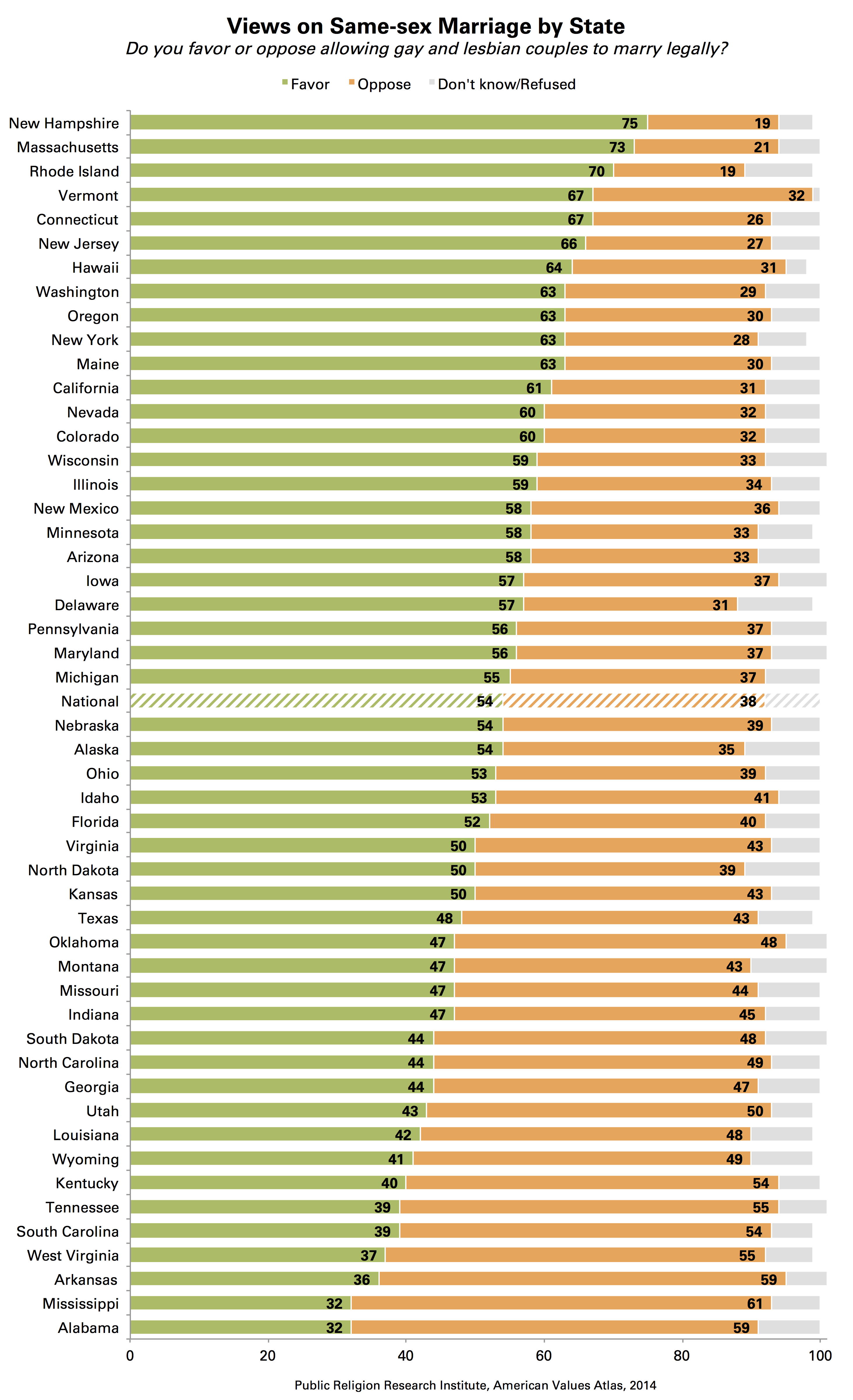
I followed the steady rise in support in the polls, until today almost 60% of Americans support marriage equality. I presented graphs and statistics.
I discussed politics and policy, identifying hypocrites and bad science.
And I made a particular point of highlighting support from people of faith, in a series called Voice of Faith. Because despite what the media narrative is, "Christian" does not equal anti-gay. Heck, the Episcopal Church just voted to change its canons and formally eliminate differences between same sex and opposite sex marriage liturgies! But I didn't hesitate to highlight the malign effects of religion as well.
Finally, of course, I have been running Videos on Sunday and other days.
The blog will stay here as a resource.
Up at the top of the page, there are tabs for permanent pages including pages about genetics and orientation, and in particular, the Prop8 timeline and theological resources to fight those religious bullies.
There's a slew of other labels on the right sidebar that you can use to find other posts.
I may be back, because we haven't finished yet. We won this particular battle, but there is a long way to go, until being gay finally becomes just a fact, like being left-handed or having red hair. And there's a lot of anger from the opposition, which is casting our rights as an assault on religious freedom.
So you may hear from me yet. But till then, please explore what's here and celebrate the journey.
Showing posts with label marriage. Show all posts
Showing posts with label marriage. Show all posts
Tuesday, August 4, 2015


Sunday, July 19, 2015
Monday, July 6, 2015
Voices of Faith: Episcopal Church makes marriage official
 |
| Click image for more Voices of Faith |
Out gay bishop Gene Robinson reflects on how the Episcopalians got there.
While the resolutions passed overwhelmingly, there's a small handful of dioceses whose bishops disagree, and they are able to refuse permission to marry LGBT people. However, they must provide some access to marriage. Whether this is a phone number to a neighboring diocese, or the ability to import a priest, or ecumenical strategies with the Lutherans (the ELCA and The Episcopal Church are in communion with each other), remains to be seen.
Still, it's great news as the Episcopalians join other churches including Lutheran and Presbyterian in allowing same sex marriages. Or as we can now call it, marriage!
Thursday, July 2, 2015
A brief history of how we got here
This excellent article in the Atlantic tells the whole story, starting with a man named Baker....
When Wolfson was a law student at Harvard in 1983, his adviser tried to discourage him from writing his thesis on gay marriage, on the grounds that it was too far-fetched. Sullivan’s 1989 New Republic essay, “Here Comes the Groom,” got a similar reception. “It was difficult just to get past the laugh factor at the beginning,” Sullivan recalled. “I remember going on Crossfire in the early days and having Gary Bauer laugh in my face—‘It’s the most bizarre and silly idea to come down the pike in a long time! It’s ludicrous!’”and then, how the message changed after the cluster of the Prop8 campaign, as the participating groups started to strategize together
There was stiff resistance within the movement to the new approach. Some thought it made no sense or wasn’t aggressive enough; some resented the strictly vetted, disciplined, sanitized faces the movement was putting forth. But in 2012, after 31 straight losses for gay marriage at the ballot box, Freedom to Marry spearheaded a centralized, politically savvy, message-tested campaign in four states—Maine, Maryland, Minnesota, and Washington. On Election Day, the gay-marriage side won in all four states.
Wednesday, July 1, 2015
Religious freedom and civil marriage
Several states are resisting implementation of the Court's decision on same sex marriages, by throwing up the "religious freedom" meme.
The most extreme example is this, in which a lawyer under Alabama Justice Roy Moore claims
Public officials are ministers of God assigned the duty of punishing the wicked and protecting the righteous.Well, that's patently not true. Alabama is NOT a theocracy and neither are these United States, and the oath to uphold the Constitution that they all took is not predicated on "when it agrees with my religious views."
In Michigan, efforts to protect "religious freedom" are renewed, including a demand that marriages only exist in religious settings.
Conservatives in the House have introduced legislation that would only allow religious clergy to perform marriage ceremonies and remove that responsibility from local clerks and judges. Other couples who don't want to use clergy for their nuptials could provide an affidavit of marriage to county clerks. The legislation also would allow marriage certificates to be shielded from public record laws.But that is putting religion front and center in a CIVIL contract. That is WRONG.
"If this legislation becomes law it will protect our public officials from having to perform same-sex marriages and put the marriage licensing business back in the position of being in the realm of the churches and religious leaders," said state Rep. Todd Courser, R-Lapeer, in a statement explaining the bill he sponsored.
In Texas, the Attorney General has suggested that clerks are free to refuse licenses on religious grounds. The Dallas Morning News correctly states,
The U.S. Supreme Court ruled Friday that same-sex couples have equal rights to marry. Top Texas leaders must stop standing in the way by encouraging government employees to invoke a personal religious exception when asked to provide marriage-related services, such as issuing licenses or officiating at civil ceremonies.Exactly.
Denton County Clerk Juli Luke struck the right tone regarding Friday’s ruling by stating, “Personally, same-sex marriage is in contradiction to my faith and belief. … However, first and foremost, I took an oath on my family Bible to uphold the law, and as an elected public official, my personal belief cannot prevent me from issuing the licenses as required.”
State employees do not have discretion to selectively embrace the constitutional protections they agree with while rejecting those they object to, even on religious grounds. Constitutionally, governments — including their employees — must present themselves as religiously neutral.Look, this is not a religious issue. Civil marriages are civil contracts. I haven't noticed Roman Catholic clerks refusing licenses to previously divorced people, although such marriages are disallowed by their faith. Nor devoutly orthodox Jews refusing licenses to interfaith couples. This is only about bias against LGBT people. And it needs to stop.
Sunday, June 21, 2015
Monday, April 27, 2015
It's not Gay Marriage vs Church any more (voices of faith)
|
| Click image for more Voices of Faith |
Not when clear majorities of Americans generally, and of most Christian faith groups, support marriage equality.
William Eskridge writes in the NY Times:
My point is not that the Bible must be read in a gay-friendly way; it is simply that the Bible is open to honest interpretations that refuse to condemn or that even embrace such families. I am doubtful that Scripture speaks with one voice about how to define civil marriage.And most importantly,
....Assume that the Supreme Court interprets the 14th Amendment to mean that states can’t exclude gay couples from civil marriage. What will the faith traditions, which are adamantly opposed to same-sex marriage, do? The tolerant path I’ve suggested won’t unfold immediately, and different denominations will respond in different ways.
Some congregations will double down, not only reaffirming their understanding of traditional marriage but denouncing gay people even more fervently. The First Amendment gives them the right to react this way.
But if all 50 states issue marriage licenses on an equal basis, more same-sex couples will choose to wed. Some religious communities will take this as an opportunity to reconsider their views of those committed unions, and quietly welcome these families into their houses of worship.
With greater tolerance and acceptance of gay married couples, more religions will, slowly, modify doctrinal discourse to match social discourse — exactly the way they did for their previous disapproval of marriages between two people of different races. ...
Today, some progressives harbor inaccurate stereotypes about religious people as anti-gay and intolerant. The Episcopalians, Unitarians, Presbyterians and many other faiths are falsifying those stereotypes. Just as American religion is changing, so, too, are the ranks of those who are pushing for equality.As one Prop8 proponent conceded, we will be more American on the day all of us can marry equally.
Monday, April 20, 2015
Same sex marriage actually a win for traditionalists
Conor Friedersdorf in the Atlantic:
Gay marriage has been successful in the courts precisely because, given both the actual behavior of married Americans and the prevailing legal logic of many decades, it was impossible to maintain the fiction that civil marriage remained an inherently procreative institution, even if sacramental marriage in some faiths remains so. It took the arrival of gay marriage to wake some traditionalists up to the fact that that religious and secular notions of what marriage is had long since parted ways. But the logic of same-sex marriage requires no leaps beyond what heterosexuals had already made. It fits within the Enlightenment model of civil marriage as a contract. For traditionalists, its logic is such that nothing new is lost....Why? Because if civil unions/domestic partnerships had been the norm, straights would have wanted access to them too, precisely because they weren't marriage. That's what happened in France, for example.
Instead, a culturally influential minority is now included in marriage, so it remains the default way that couples join; religious people are as free as ever to marry in a fully traditional sense; and secular straights retain more traditional aspects and attitudes than they would if they'd switched over to a new paradigm of coupledom.
Wednesday, March 4, 2015
Tuesday, February 24, 2015
Marriage opportunity: fighting the marriage gap
Writing in the Washington Monthly, Jonathan Rauch, David Blankenhorn (former equality opponent) and others argue that the marriage crisis in the US is not due to same sex marriages but due to the class limits. Marriage is doing fine in better-off demographics, but is not doing well in poorer communities. And yet, marriage is an agent of stability and well-being, and kids really DO do better with stable, two parent families. (Sexuality is not the issue).
They argue,
Many advocates of strengthening the family, for many years, have praised the two-parent married family as a touchstone of America’s economic and moral vitality. So it is, but where marriage advocates may often have gone wrong in the past was to imply that those who could not or did not conform to the standard template—gays, single mothers, and others—were opponents rather than potential recruits. In fact, what the same-sex marriage movement shows is that gay and lesbian Americans did not want to undermine marriage: they wanted to join it.and gay couples are a big part of this.
Increasingly, it is becoming clear that the same is true of many single mothers and fathers: they are not rejecting family values so much as feeling rejected by them, or at least unable to sustain them. No doubt, there are people out there who purposefully reject social norms like marriage and parental responsibility. But they are not the typical case or the case to which public policy should primarily address itself. The constructive focus is on the many more who would like to practice family values, if only they had the social, cultural, and economic capital to do so.
This is why we stress marriage opportunity. Changing minds and hearts has much value, but as a social-policy goal, removing impediments to success is more achievable and less polarizing. More important, improving opportunity has been, arguably, the great unifying American idea since before the days of the Declaration of Independence. Speaking of marriage opportunity is as natural in American public conversation as speaking of social opportunity and economic opportunity. It is a goal Americans can broadly agree on.
Establishing marriage opportunity for gays and lesbians is an important dimension of expanding marriage opportunity in America—not only for gay and lesbian couples, but, as we’ve tried to suggest, also for the nation as a whole. Supporting gay couples who seek to form lasting unions, gay parents who seek to raise successful children, and gay young people who aspire to a future in marriage—this is part and parcel of reestablishing a culture of marriage. And it brings society that much closer to ending forever the conflict between gay rights and family values: that is, to being a society in which all Americans, regardless of sexual orientation or social class, can aspire to a rich family life and a lasting marriage in a supportive community.
Friday, January 16, 2015
Here we go: SCOTUS grants cert
As predicted, the Supreme Court decided to address the split in circuits (with the 6th circuit upholding equal marriage bans). They have granted certiorari to all the cases from the 6th circuit, with arguments in April and a decision in June.
Is this the endgame? What will be the civil rights legacy of the Roberts court?
From the NY Times:
Is this the endgame? What will be the civil rights legacy of the Roberts court?
From the NY Times:
The Sixth Circuit’s decision upheld bans on same-sex marriage in Kentucky, Michigan, Ohio and Tennessee. The Supreme Court agreed to hear petitions seeking review from plaintiffs challenging the bans in each of those states.
The court said it will hear two-and-a-half hours of argument, probably in the last week of April. The first 90 minutes will be devoted to the question of whether the Constitution requires states “to license a marriage between two people of the same sex.”
The last hour will concern a question that will be moot if the answer to the first one is yes: whether states must “recognize a marriage between two people of the same sex when their marriage was lawfully licensed and performed out-of-state.”ThinkProgress is hopeful:
Although the Court is unlikely to hand down a decision on marriage equality until June at the earliest, it may have already tipped its hand. Last October, before the Sixth Circuit weighed in, the Court began denying review of lower court decisions ruling in favor of marriage — an act that also had the effect of allowing those decisions to go into effect in many states. A decision against equality at this stage could potentially unmarry couples who benefited from those lower court decisions. At the very least, it would create the anomalous situation where people who got married before a certain date would remain married, but no new same-sex marriages would be permitted in some states.
It is unlikely that a majority of the Court would have allowed these lower court decisions to take effect unless they believed that the Supreme Court was likely to rule the same way.
Sunday, January 4, 2015
Friday, December 26, 2014
SCOTUS to consider whether to decide
As we all know by now, the Supreme Court doesn't grant a hearing to all appeals put before it. They consider them in a conference, and then decide whether to decide.
Box Turtle Bulletin:
Let's hope we have a happy new year!
The Supreme Court has scheduled January 9, 2015, as the date on which to consider whether to hear appeals in five marriage cases. The states from which these cases originate are Tennessee, Kentucky, Ohio, Michigan and Louisiana.Since there's a split in the circuits (with the 6th ruling against equality), the Court is likely to step in.
In Louisiana a federal judge ruled to uphold the anti-gay marriage ban, and the other four are in the Sixth Circuit, where the appeals court overturned federal judges who had ruled for equality.
We will not know until next month whether SCOTUS will hear any marriage appeals, but if they do so, it will only be those which are requesting that marriages be allowed. In other words, the court has not scheduled for hearing any appeals which could reverse a state’s current practice of allowing same-sex marriage.
Let's hope we have a happy new year!
Tuesday, November 18, 2014
Get married, get fired?
From Al Jazeera (BTW, I really like their reporting)
[T]he dilemma now facing a growing number of gay couples: They can legally marry, but they may also be fired from their jobs, thrown out of their apartments and denied service at businesses because of their sexual orientation. Many say the increased visibility of same-sex partners, even in small towns in conservative states, will lead to greater acceptance of gays. But particularly in the short to medium term, it could prompt more instances of discrimination.
...
“I didn’t expect marriage equality to happen so quickly — and it’s a good thing. I’m not complaining,” says Ted Martin, executive director of Equality Pennsylvania, an LGBT advocacy group. “But because you don’t have civil rights protections in place, someone even talking about their marriage could be used as grounds to terminate someone.”
Thursday, November 13, 2014
Kansas and South Carolina
We added Kansas and South Carolina this week...at least, technically, although they are still kicking and screaming. Here's the map from ThinkProgress.
So, who's left?
A Federal Judge in Mississippi heard a case this week.
The 5th Circuit (TX, MS and LA) and 11th circuit (FL, AL, GA) have cases moving up from the states. Cases are pending in SD, ND, and NE and AR; these haven't had federal rulings yet or circuit decisions. MO is (like KS and SC) trying to resist the circuit ruling that applies. In Puerto Rico the case may be moving up to the 1st circuit. (All the states in the 1st have already got marriage equality.)
I will bet that we will have 50-state marriage equality by the summer of 2016. I think it is possible that the Supremes will hold off on a case this year.

So, who's left?
A Federal Judge in Mississippi heard a case this week.
The 5th Circuit (TX, MS and LA) and 11th circuit (FL, AL, GA) have cases moving up from the states. Cases are pending in SD, ND, and NE and AR; these haven't had federal rulings yet or circuit decisions. MO is (like KS and SC) trying to resist the circuit ruling that applies. In Puerto Rico the case may be moving up to the 1st circuit. (All the states in the 1st have already got marriage equality.)
I will bet that we will have 50-state marriage equality by the summer of 2016. I think it is possible that the Supremes will hold off on a case this year.
Monday, October 6, 2014
A quiet earthquake for marriage equality
When from out of the blue
And without any guide,
You know what your decision is....
Which is not to decide
"On the Steps of the Palace", Stephen Sondheim
The Supreme Court today denied certiori to seven different cases involving marriage equality. By denying cert, the court essentially says that the decisions from the lower courts stand. This may be because those lower courts all agreed with each other, and have been falling all over themselves to find for equality. Without a disagreement between the lower courts, there's not a conflict that requires the Supreme Court to solve. This suits the Court, which prefers to let trends get hammered out by the states before taking a step.
So this decision not to decide brings marriage to Virginia, Indiana, Wisconsin, Oklahoma, and Utah.
I know, Utah. Right? (After what they did to us in CA it's hard not to enjoy this....)
But wait, there's more!
The decisions came from the 4th, 7th, and 10th circuit courts of appeal, which means that other states that still have bans in those circuits are also affected, giving a total of 11.
- 4th: Virginia , West Virginia, North Carolina, and South Carolina.
- 7th:Wisconsin, Indiana
- 10th: Utah, Oklahoma, Wyoming, Colorado, and Kansas as well.
THinkProgress gives us the map. Potentially 30 states will have equality, and 60% of the population.
It is possible (or even likely) that one of the remaining circuits will uphold a marriage ban, as those circuits tend to have more conservative judges. And that may be the case that the Supreme Court eventually takes.
As always, the most detailed information can be found at Scotusblog.
As always, the most detailed information can be found at Scotusblog.

Sunday, September 21, 2014
Marriage, after 70 years (video Sunday)
By now, you've heard the news of two women in Iowa who have been partners for 70 years, who got married. Oh, I can just hear the sanctity of marriage tumbling down! (NOT!) It's a very charming story.
Thursday, September 18, 2014
Who takes marriage most seriously?
A columnist at the HuffPo writes about her thoughts upon attending her gay brother's wedding. And about what she learned about "the sanctity of marriage".
Weddings mark the start of a shared union -- a lifelong partnership between two people who have chosen to make binding promises to one another. Promises that often involve agreeing to work on the marriage when it needs to be worked on and to fight for it when it needs to be fought for.
And if I had to guess which couples would be likely to work and fight the hardest for their marriages, I would predict it to be those who have already worked hard and fought to make marrying their partners a possibility in the first place.
.....
Marriage is, indeed, sacred. But if proponents of traditional marriage are truly worried about sanctity, doesn't taking marriage away from those who likely revere it the most -- the same-sex couples like my brother and his husband whose ceremonies are far more focused on the extreme gratitude over their ability to be legally recognized in marriage than the cosmetic details of the day -- seem to contradict what they are after?
Tuesday, July 29, 2014
Anti equality arguments just get sillier and sillier
From Slate:
Judge Vaughn Walker raised [a] point with a lawyer defending California’s Proposition 8, demanding to know “how permitting same-sex marriage impairs or adversely affects” straight people’s marriages. The lawyer had this response: “Your honor, my answer is: I don’t know. I don’t know.”
The problem here, of course, is that an honest answer—“your honor, we believe gay people will destroy the marital institution altogether”—would undermine the supposedly secular, animus-free nature of these arguments. In developing them, anti-gay activists began with a conclusion—gay people don’t deserve the rights that we straight people have—then worked backward, camouflaging each prejudiced premise with a supposedly neutral talking point. Under any kind of scrutiny, these theories instantly fall apart, revealing their bigoted, constitutionally impermissible core.
...
And yet the inanity continues full-throttle, because gay marriage opponents have backed themselves into the corner they’ve always dreaded. They can’t give up their quest now—but they’re barred from citing the explanations that they truly believe, deep down, to be correct. The result is the current tailspin of idiocy, a shifting argument with rootless standards roaming from rationale from rationale in a desperate attempt to find shelter from the storm of progress swirling around it. It’s a pathetic display, but not an unpleasant one to witness. Stripped of all logic and reason, the argument against gay marriage has been reduced to gibberish. Enjoy the babbling while it lasts.
Friday, May 23, 2014
Five reason equality is winning
Great article in the WaPo identifies 5 reasons we are winning.
1. Rapid cultural shifts: more gay people coming out
2. An ally in the White House: the President evolved
3. A problem of overreach: if the other side had compromised, offering civil unions and legal rights, but they went out of their way to deny us any recognition
4. Religious influence rises — and falls: the rise of the nones
5. Belligerence
2. An ally in the White House: the President evolved
3. A problem of overreach: if the other side had compromised, offering civil unions and legal rights, but they went out of their way to deny us any recognition
4. Religious influence rises — and falls: the rise of the nones
5. Belligerence
Perhaps the biggest obstacle facing proponents of traditional marriage was a negative image that they were never able to overcome. While chafing at comparisons to racism and Jim Crow laws, the matriarch of the traditional marriage movement, Maggie Gallagher, concedes that her side has been labeled as “hateful and bigoted.” ...
Some conservative activists say they brought it on themselves.
“There was the evangelical belligerence, often, in the last generation that spoke, for instance, about the gay agenda, in which there was this picture, almost as though there is a group of super villains in a lair, plotting somewhere the downfall of the family,” Moore told a gathering of journalists in March.
Conservatives also weathered a host of guilt-by-association charges, which were equally hard to dislodge. In Arizona, a bill that supporters said would protect religious freedom was conveyed as license to turn gays away from public businesses. Evangelical opposition to homosexuality was exported to Africa, which took the form of harsh laws to jail or even sentence to death known homosexuals.
In short, it was no longer popular or politically correct to stand against popular culture and a swiftly changing popular opinion.
“They showed no compassion for gay people, they didn’t offer any substitutes like protecting gay families or gay kids,” Rauch said. “That lack of compassion came through. It took a little while to register, but the American public does not like lack of compassion.”
Subscribe to:
Posts (Atom)