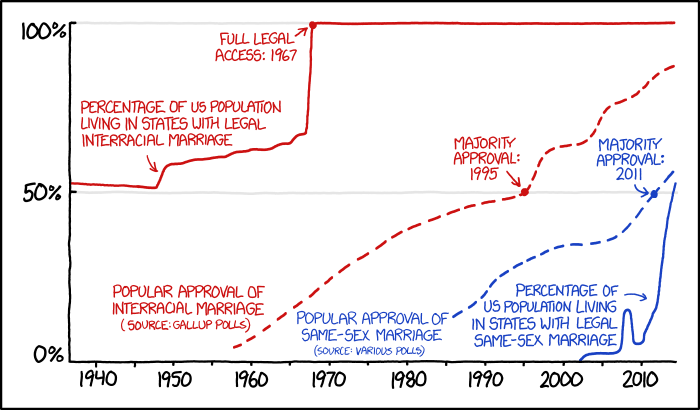
Just for grins, here's my version from 2012:

When from out of the blue
And without any guide,
You know what your decision is....
Which is not to decide
"On the Steps of the Palace", Stephen Sondheim

If I were permitted to draw aside the veil of private life, I would briefly give you the singular, and to me most interesting history of two maiden ladies who dwell in this valley. I would tell you how, in their youthful days, they took each other as companions for life, and how this union, no less sacred to them than the tie of marriage, has subsisted, in uninterrupted harmony, for forty years, during which they have shared each other’s occupations and pleasures and works of charity while in health, and watched over each other tenderly in sickness; for sickness has made long and frequent visits to their dwelling. I could tell you how they slept on the same pillow and had a common purse, and adopted each other’s relations, and how one of them, more enterprising and spirited in her temper than the other, might be said to represent the male head of the family, and took upon herself their transactions with the world without, until at length her health failed, and she was tended by her gentle companion, as a fond wife attends her invalid husband. I would tell you of their dwelling, encircled with roses, which now in the days of their broken health, bloom wild without their tendance, and I would speak of the friendly attentions which their neighbors, people of kind hearts and simple manners, seem to take pleasure in bestowing upon them, but I have already said more than I fear they will forgive me for, if this should ever meet their eyes, and I must leave the subject.They are the subject of a new book, Charity & Sylvia: A Same-Sex Marriage in Early America by Rachel Hope Cleves.
 |
| Click image for more Voices of Faith |
Marriage is this arena where we can totally give ourselves to another person in body, spirit, and life and commitment and grow in that total gift of self which winds up being an image of Jesus’ total gift of himself for us.Achtemeier used to be ardently opposed to marriage equality, and considered being gay "like drinking poison". But no more:
One of the things that was powerful for me in breaking out of that mindset was testimony about the blessings that came to gay and lesbian people through their committed relationships. Early in the book I talk about a conversation with a friend who said they knew all about identifying sin in their life and repenting of it, but when they thought about marriage to their partner, that’s what brought out the best in them and helped them learn love and self-sacrifice and nothing that needed to be repented of.Yet another reason why we must continue to come out ! Minds do change!
That really struck me that it sounded like my marriage.
The other thing that took me a long time to wrap my mind around is that an awful lot of Evangelicals really haven’t grappled with recognizing that this is not something you could choose your way out of. There’s always this sense of, “If you really tried hard, or prayed hard enough, you could come around.” Again, my gay friends would say, “Why on earth would I choose something like this? Who needs all this trouble?”
I think it’s the willingness of gay and lesbian people in sharing their stories that finally got it through my thick head that this isn’t an optional lifestyle, it’s a given.
Weddings mark the start of a shared union -- a lifelong partnership between two people who have chosen to make binding promises to one another. Promises that often involve agreeing to work on the marriage when it needs to be worked on and to fight for it when it needs to be fought for.
And if I had to guess which couples would be likely to work and fight the hardest for their marriages, I would predict it to be those who have already worked hard and fought to make marrying their partners a possibility in the first place.
.....
Marriage is, indeed, sacred. But if proponents of traditional marriage are truly worried about sanctity, doesn't taking marriage away from those who likely revere it the most -- the same-sex couples like my brother and his husband whose ceremonies are far more focused on the extreme gratitude over their ability to be legally recognized in marriage than the cosmetic details of the day -- seem to contradict what they are after?
With lawyers moving very rapidly, the number of appeals to the Supreme Court on same-sex marriage rose on Tuesday to seven, as state officials in Indiana and Wisconsin separately challenged a federal appeals court ruling against their bans, and lawyers for the couples planned to file immediate replies. The new cases landed at the Court five days after that decision; the states had the option of taking ninety days to file.
...
The Court has the option of taking on either or both issues, and it also has the option of putting off any consideration for the time being, despite the heavy pressure from virtually everyone involved in the cases, who contend that the Court should not wait any longer to decide. None of the cases is a mandatory appeal. It would be highly unusual, however, for the Court to pass up all of the cases, when everyone is championing review now.
If the Court opts to take on the controversy anytime up to mid-January, a final ruling could be expected before the new Term is completed late next June.And guess what? The case may well rest not on constitutional law, not on fairness, but on religious freedom. Mark Silk at Religion News Service on an amicus brief filed for Utah:
The religious organizations make clear in their amicus brief that, besides addressing all relevant Fourteenth Amendment issues, the Utah case uniquely addresses the burden placed on religious liberty by SSM. Quoting from a 2012 letter from a coalition of anti-SSM religious leaders, they write:Judicially redefining marriage powerfully conflicts with religious liberty because, among other reasons, such a dramatic change in the law inevitably will lead to “forcing or pressuring both individuals and religious organizations – throughout their operations, well beyond religious ceremonies – to treat same-sex sexual conduct as the moral equivalent of marital sexual conduct.”…
Utah’s petition provides an opportunity to address whether avoiding religious conflicts and church-state entanglements is a sufficiently weighty reason, alone or combined with other interests, to warrant allowing States to retain the age-old definition of marriage.
If the court did find such avoidance sufficiently weighty, I’ve no doubt that the next legal step would be to ask that all states be forbidden to permit SSM on religious liberty grounds. But the real significance of the brief, it seems to me, is that it represents an acknowledgment that SSM is becoming the law of the land, and that the battle has now moved to the securing of legal exemptions for religious objectors.So, the logic here is that anti-gay archbishop Salvatore Cordileone's religions freedom demands that the state deny me my civil rights (not to mention any non-Catholic church's religious freedom to marry me). The sad thing is, after Hobby Lobby, it's just what might appeal to the 5 Catholics on the bench in DC.
In a new blog post by IFI’s Laurie Higgins this week, the group takes on a new target: the children of same-sex couples, who Higgins expects would find “joy” in imagining their parents dead.
....Her primary concern is that children should not ever see books about same-sex families, deeming any portrayal of a same-sex couple as “homoeroticism” and “sexual perversion.” Instead, she suggests that librarians consider adding the following kinds of books (granting the premise that such books even exist):....
- Young adult (YA) novels about teens who feel sadness and resentment about being intentionally deprived of a mother or father and who seek to find their missing biological parents.....
- Picture books that show the joy a little birdie experiences when after the West Nile virus deaths of her two daddies, she’s finally adopted by a daddy and mommy.
Heterosexuals get drunk and pregnant, producing unwanted children; their reward is to be allowed to marry. Homosexual couples do not produce unwanted children; their reward is to be denied the right to marry. Go figure.From Slate, an analysis,
There is simply no harm, Posner writes, “tangible, secular, material—physical or financial, or … focused and direct” done to anybody by permitting gay marriage. Conservative Christians may be offended, but “there is no way they are going to be hurt by it in a way that the law would take cognizance of.” A lot of people, after all, objected to interracial marriage in 1967—but that didn’t stop the court from invalidating anti-miscegenation laws inLoving v. Virginia.
In his opinion, Posner makes these points with trenchant humor. But beneath his droll wit lies a moral seriousness that gay marriage opponents, even those on the high court, will be unable to shrug off. The modern arguments against gay marriage may be breathtakingly silly—but by mocking them, we ignore the profound harms that marriage bans inflict on gay people and their families. By placing these families at the center of his analysis, Posner restores the equal protection clause to its rightful place as the safeguard for all whom the state seeks to harm unjustly. His message for those who hope to demean gay people and their children is clear: Not on my watch.
|
| Click image for more Voices of Faith |
To be clear, my view of marriage in a spiritual context has not changed. I believe the wedding union of husband and wife bears the image of God uniquely.....
What I am also trying to learn is how I can state my beliefs without being a jerk about it. ...
I have also come to believe that trying to make our secular government impose mySo, he's not a supporter per se, but he seems to get the separation of faith and civil law. I'm perfectly okay with that. It's progress. He goes on,
spiritual beliefs in this matter is not helpful or appropriate.
The night that Prop 8 in California and Amendment 2 in Florida (both banning gay marriage) passed I was jubilant. I truly believed what we had done was right and good. ....What I didn’t make widely known was how heart-broken I was when I saw the gay community in California take to the streets. Their protests that night and in the days afterwards tugged at me. When I saw their grief-stricken faces my heart twisted in my chest. It was the first time in a long time I remember thinking, “did we do something wrong?” ...Eventually the doubt over what we had done would get louder in my mind and change from a question to a conviction; a conviction that indeed we had done something terribly wrong.He concludes
Today, I can honestly say that I am glad that the courts are striking down all the marriage bans across the country. It is my hope that we (Christians) can learn from the past, make the appropriate amends, and rebuild dialog and relationships with the LGBT community.There are a number of prominent evangelicals who are coming around to being pro-marriage equality -- Brian McClaren, Steve Chalke, Rob Bell, Ken Wilson.... Most of them get rejected by their communities as apostates. But the tide is turning. And I would remind my fellow members of the rainbow tribe that forgiveness is a virtue. Life is too short to hold a grudge. Let's move ahead for justice, together.
Political operatives seeking to cast aspersions on Feldman’s approach to gay rights will find a lot to work with in his opinion. At one point, he describes being gay as one of several “lifestyle choices” a person can make. At another point in his opinion, he compares same-sex marriage to marriage between “aunt and niece,” “aunt and nephew,” or “father and child.” He also likens marriage equality to polygamous marriages.He also seems a little confused about the 14th amendment, which is not limited to issues of race. This one will head up to the 5th circuit for appeal.
Judge Richard Posner, who was appointed by President Ronald Reagan, was dismissive when Wisconsin Assistant Attorney General Timothy Samuelson repeatedly pointed to 'tradition' as the underlying justification for barring gay marriage.
"It was tradition to not allow blacks and whites to marry — a tradition that got swept away," Posner said. Prohibition of same sex marriage, he said, is "a tradition of hate ... and savage discrimination."
Posner frequently cut off Indiana Solicitor General Thomas Fischer, just moments into his presentation and chided him to answer his questions.
At one point, Posner ran through a list of psychological strains of unmarried same-sex couples, including having to struggle to grasp why their schoolmates' parents were married and theirs weren't.
"What horrible stuff," Posner said. What benefits to society in barring gay marriage, he asked, "outweighs that kind of damage to children?"Court watchers think this one will go our way.
The MPAA movie ratings are supposed to provide information on a movie's content, so parents can decide whether or not it's suitable for their children.
But what kind of information are they really providing? And what are they assuming we want to protect our children from?
On Friday, "Sin City: A Dame to Kill For" will be released in a wide number of theaters. It features nudity, sexual situations and substance abuse. Every woman in it is a stripper, a prostitute or a murderer. There is violence and graphic gore,...It is rated R.
That day, "Jersey Shore Massacre" also reaches theaters. It features nudity, sexual situations, substance abuse and ethnic and racial slurs. There is violence and graphic gore....It is rated R.
Also opening is "Love Is Strange." There is no nudity. There are no sexual situations. The drug or alcohol material mostly consists of adults having wine with dinner, or cocktails at a bar. There is no violence or gore. There are several scenes of men kissing, and two scenes of a gay couple sleeping together, fully clothed, in bed. It is rated R.
If there's an equivalence among these three films, and their equal unsuitability for anyone under 17, it's lost on me — and, I suspect, on anyone but the censors at the MPAA.
Not only is there nothing violent in "Love Is Strange," there's not even anything explicit. It is about as mild and mainstream a portrayal of gay life as you can imagine. Ben, played by John Lithgow, is a 71-year-old retiree. George, played by Alfred Molina, is a music teacher at a Catholic school. In the film, they have been together for nearly 40 years (until, in a unfair and sudden reversal of fortune, they lose their apartment).
It's a simple human story. And it is very hard to imagine that — if it starred, say, Robert Duvall and Jane Fonda as a similar long-time couple suddenly facing homelessness — it would be lumped in with movies crammed full of queasily stylish sexism and sickening torture porn.
.....
This is a gentle, if often heartbreaking story about two loving men in a long-time committed relationship. What on earth is in it that so horrifies the MPAA?
I'm sorry. I think I just answered my own question.
In the Virginia case, the fervor of the ban is unmatched—not only does its ban deny marriage to same-sex couples, but it also seeks to deny them from acquiring any of the rights of marriage through other means, such as civil unions or domestic partnerships. The plaintiffs, two couples, each represent one aspect of the ban’s two-pronged scope: the denial of both in-state marriage licenses as well as out-of state marriage licenses.
In the Utah case, the defendants’ case relies more heavily on the claim that the state is being deprived of its right to define marriage, “disenfranchising” millions of its voters. Because the Constitution doesn’t define marriage, and the Supreme Court only deems the “right to marry” as a fundamental right, Utah claims that it has been delegated the right to define what “marry” means. The defendants claim that the Tenth Circuit’s ruling undermines democracy, and the federal system.
In the Oklahoma case, more emphasis is placed by the defendants on the suspect nature of same-sex parenting. They note the uneasiness of young adults who don’t know their biological parents, or are conceived through sperm donation, though arguments from the other side rebut these claims as largely unfounded, while conflict in the social science community over that issue has also provided little evidence for the claim.But the court doesn't HAVE to take any of those cases, unless it sees a question it must answer.
With a little more than five weeks until the Justices assemble in their first private Conference, in advance of the new Term starting October 6, it is by no means clear that any same-sex marriage case will be ready for the Justices to consider it on September 29. That depends, in part, on whether the Court will have cases before it one at a time, as each is ready, or in a group., when several are ready.
The last scheduled day for distributing a case for consideration by the Justices at the September 29 meeting is September 10 — now, just three weeks away. The pending Utah case has a fair prospect of being ready then, but there is reason to doubt at this point that the pending Oklahoma and Virginia cases will be complete. The lawyers involved have said they were working diligently to push matters along, but the clock is against them for action by the Justices at the outset of the new Term.
There will be plenty of time, though, to get a case before the Court for decision during the new Term. If a case is accepted for review by sometime next January, it is almost certain to be decided before the end of the Term, late next June.

